About
I’m Rajat Joshi, a PhD candidate in the Program in Atmospheric and Oceanic Sciences at Princeton University, advised by Dr. Rong Zhang. I have a broad interest in climate dynamics and variability, and my PhD thesis focuses on investigating teleconnection mechanisms associated with changes in the North Atlantic Ocean circulation. To study these teleconnections, I typically analyze output from experiments conducted using the Geophysical Fluid Dynamics Laboratory (GFDL) coupled climate model.
Alongside my PhD research, I’m interested in the questions at intersection of climate impacts and emerging methodologies, especially:
- Leveraging Artificial Intelligence to understand drivers of extreme events (e.g., tropical cyclones) across weather-to-climate timescales and improve their predictiability.
- Understanding how proposed climate intervention strategies intended to counteract global warming (e.g., solar geoengineering) could affect the regional extreme events.
Research
On the Atlantic extratropical–tropical teleconnection in response to weakening of AMOC
The Atlantic Meridional Overturning Circulation (AMOC) is one of the crucial component of the Earth climate system and is considered to be one of the tipping elements of the Earth's climate system. In many modeling studies, the weakening of the AMOC in response to external freshwater forcing leads to a distinct horseshoe pattern of colder sea surface temperatures (SST) anomalies in the North Atlantic. This SST horseshoe pattern is a characteristic feature of the Atlantic extratropical-tropical teleconnection leading to the tropical atmospheric response associated with the AMOC weakening, such as the southward shift of the Atlantic Intertropical Convergence Zone (ITCZ).
Read more
A similar SST horseshoe pattern associated with the Atlantic Multidecadal variability (AMV) has also been observed in modern climate, with the SST anomalies propagating from the extratropical North Atlantic into the tropical North Atlantic along the horseshoe pathway. Despite its importance, the mechanisms of the Atlantic extratropical-tropical teleconnection associated with the AMOC weakening remain poorly understood. Some previous studies often attribute the equatorward propagation of cold extratropical SST anomalies to the positive Wind-Evaporation-SST (WES) feedback. However, these findings are often based on modeling results from atmospheric general circulation models (AGCMs) coupled to slab ocean models without ocean dynamics, thus neglecting the role of ocean.
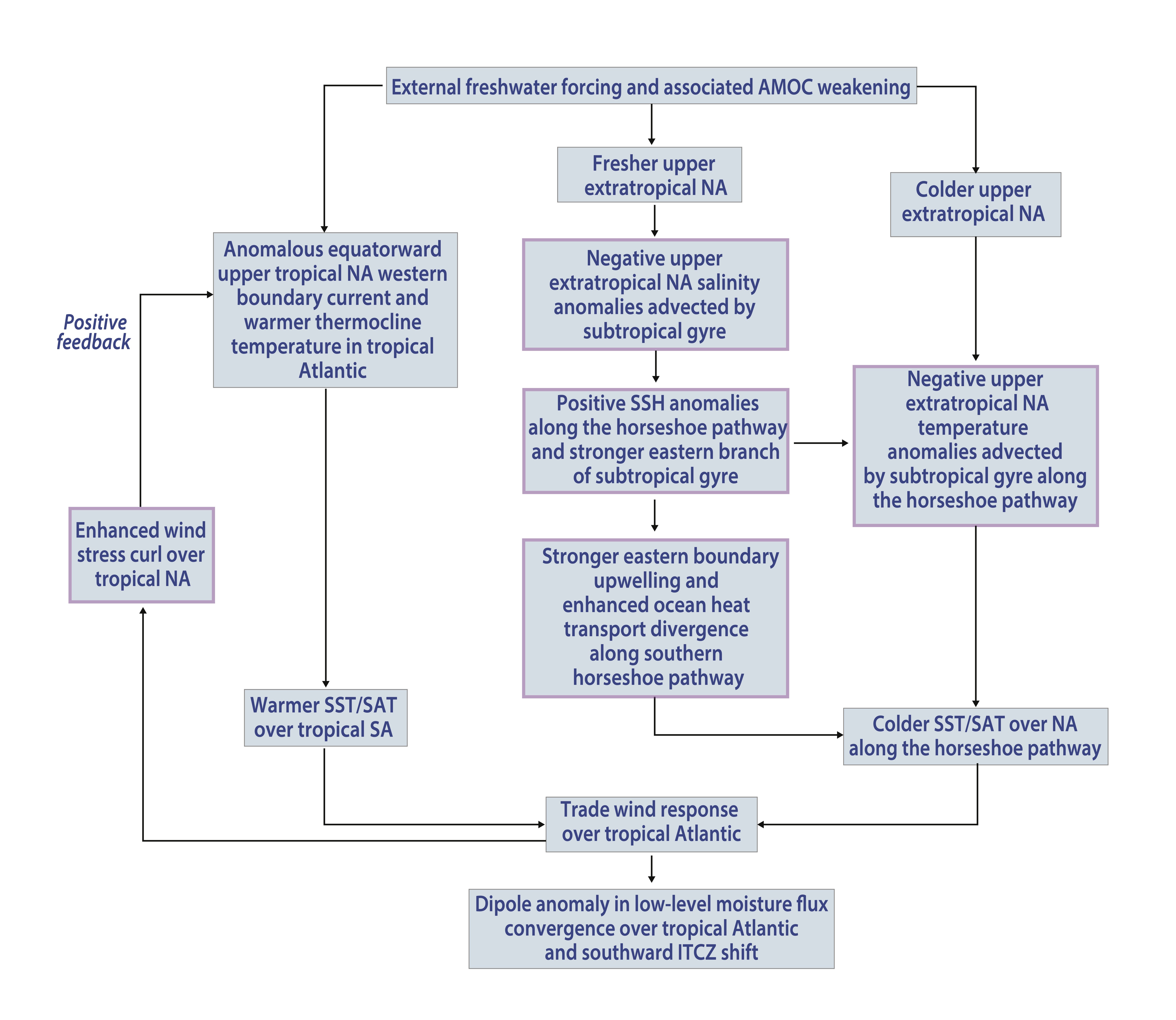
In this work, we conduct water hosing experiments using a high-resolution fully coupled climate model to elucidate the mechanisms responsible for the Atlantic extratropical-tropical teleconnection associated with the AMOC weakening. Our analysis, focusing on boreal summer, suggests that the WES feedback is not the primary mechanism for the Atlantic extratropical-tropical teleconnection. Instead, the southward advection of the upper extratropical North Atlantic signal by the North Atlantic subtropical gyre along a horseshoe pathway is a key mechanism for forming the horseshoe pattern of cold SST anomalies. Additionally, the weakening of the AMOC changes the upper tropical North Atlantic western boundary current. This change is amplified by enhanced surface wind stress curl over the tropical North Atlantic, contributing to warmer tropical Atlantic subsurface thermocline temperature and SST in the tropical South Atlantic. The dipole Atlantic SST anomalies lead to the trade wind response and associated southward ITCZ shift over the tropical Atlantic. The mechanisms of the Atlantic extratropical-tropical teleconnection are crucial for the development of the tropical atmospheric response associated with the AMOC weakening (e.g. the southward shift of the Atlantic ITCZ) and are summarised in the schematic on the left.
This work is published in npj Climate and Atmospheric Science and can be acessed via the following link. DOI: 10.1038/s41612-025-01253-z
Impacts of the North Atlantic biases on the upper troposphere/lower stratosphere over the extratropical North Pacific
The North Atlantic Ocean plays an important role in regulating various regional climate patterns because of the presence of the Atlantic Meridional Overturning Circulation (AMOC) and its associated heat transport. On multidecadal timescales, particularly during boreal winter, changes in North Atlantic sea surface temperatures (SSTs) have been argued to lead to changes in the North Pacific SSTs. Owing to the limited availability of long observational records, much of the evidence for this inter-basin linkage is derived from climate model simulations.
Read more
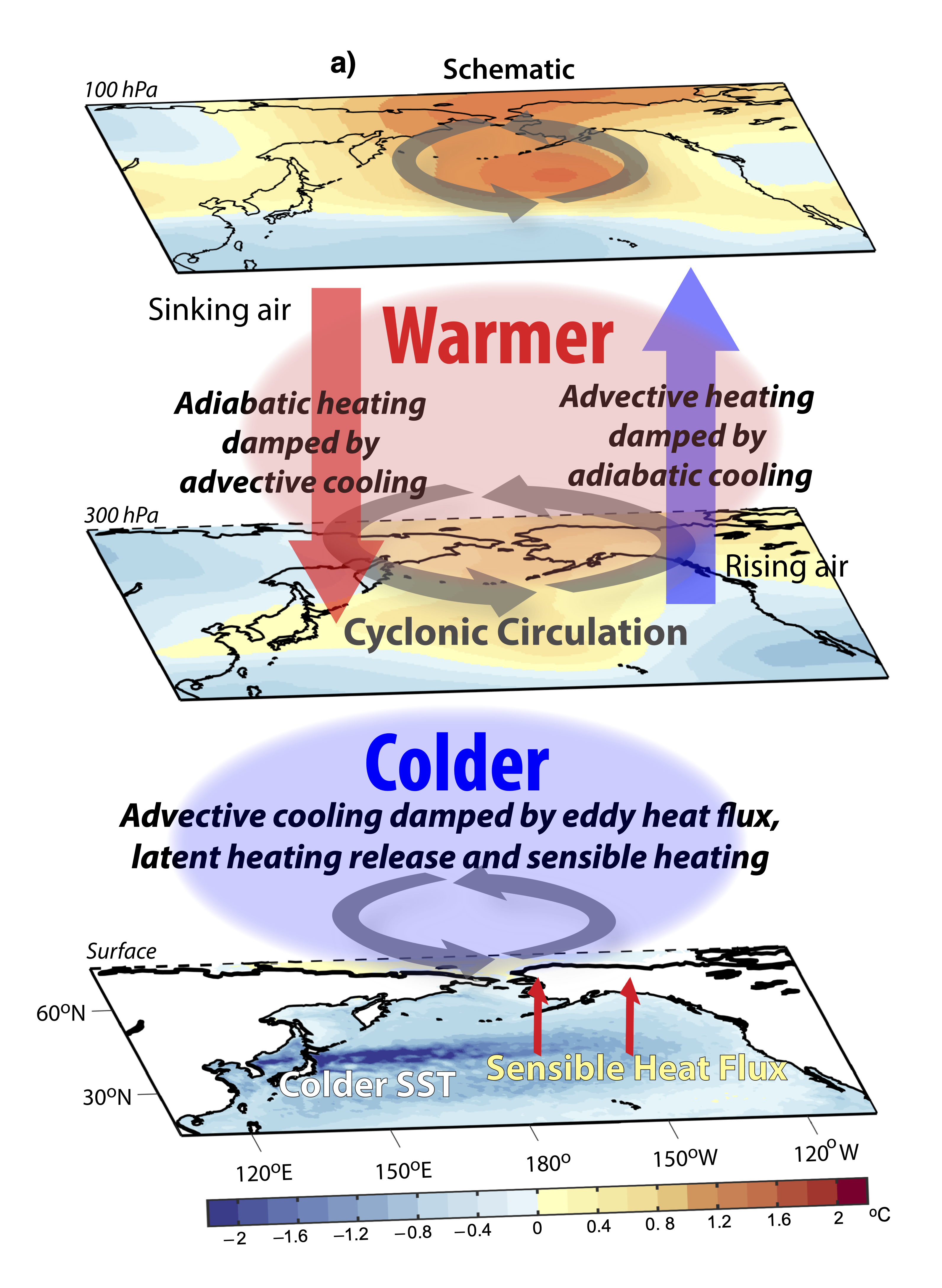
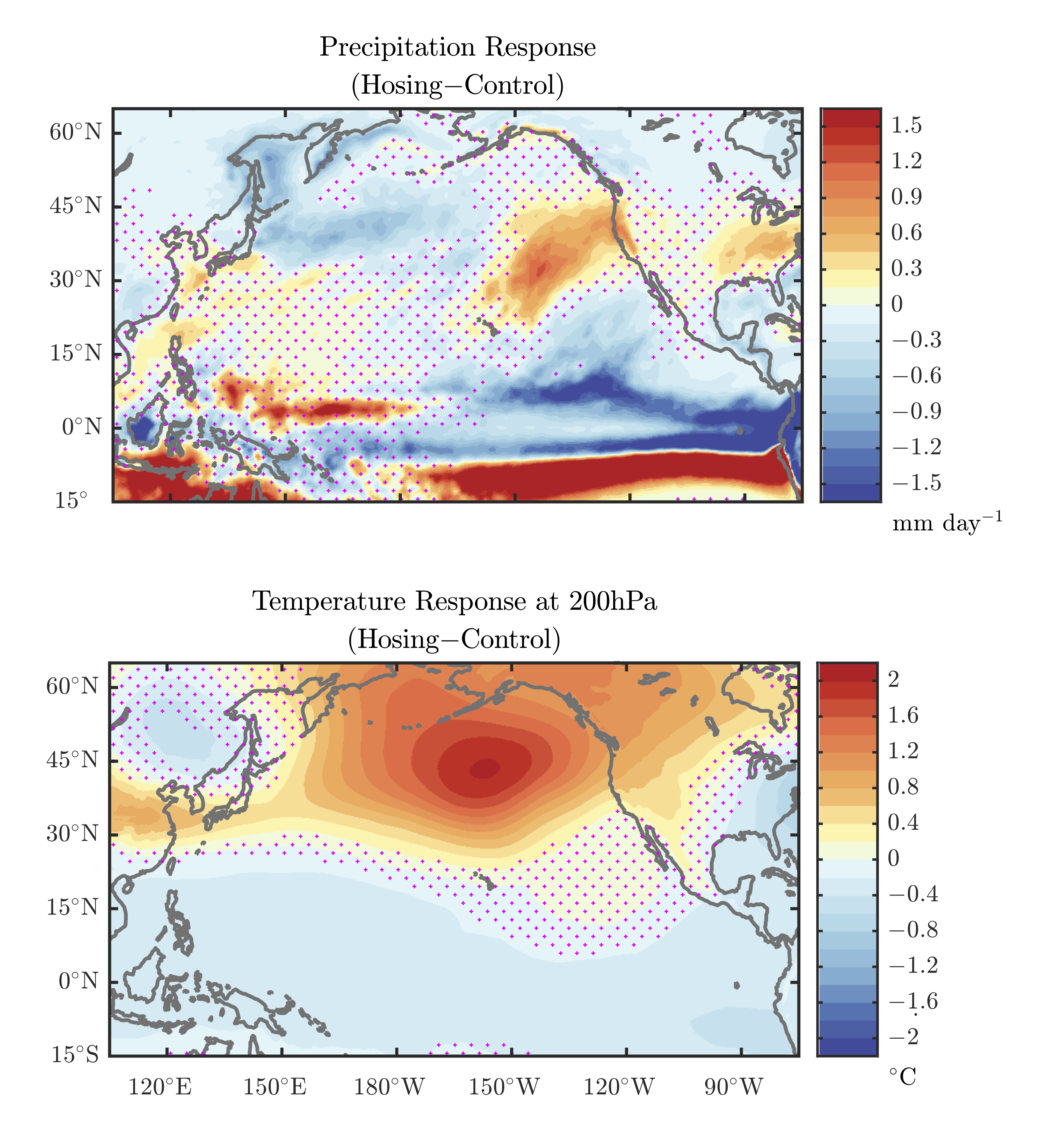
A persistent issue in many coupled climate models is the presence of cold SST biases in the North Atlantic, which are often associated with biases in the simulated strength and structure of the AMOC. These SST biases in the North Atlantic can induce SSTs biases in the North Pacific. However, the extent to which the biases in the North Atlantic affect the upper atmosphere, particularly the upper troposphere/lower stratosphere (UTLS) over the North Pacific, has not been explored. In this work, we assess the influence of North Atlantic oceanic biases on the UTLS over the extratropical North Pacific and show that during wintertime, the North Atlantic biases lead to a warmer upper troposphere/lower stratosphere over the extratropical North Pacific. Using the thermodynamic equation, we discuss the leading order thermodynamic balance in the UTLS over the extratropical North Pacific that helps sustain this warming response.
This work is published in npj Climate and Atmospheric Science and can be acessed via the following link. DOI: 10.1038/s41612-023-00482-4
Interhemispheric footprint on Indian monsoon floods
The Indian summer monsoon rainfall is often believed to be affected by the leading climate patterns such as the El Niño Southern Oscillation (ENSO). Typically, large-scale droughts over India are associated with El Niño (i.e., positive phase of ENSO), while floods with La Niña (negative phase of ENSO). However, this connection does not always hold, some major floods over India have occured even without La Niña conditions. Here, we try to comprehend- (i) the rainfall characteristics of such floods, and (ii) the dynamical conditions that contribute to these large-scale floods over India.
Read more
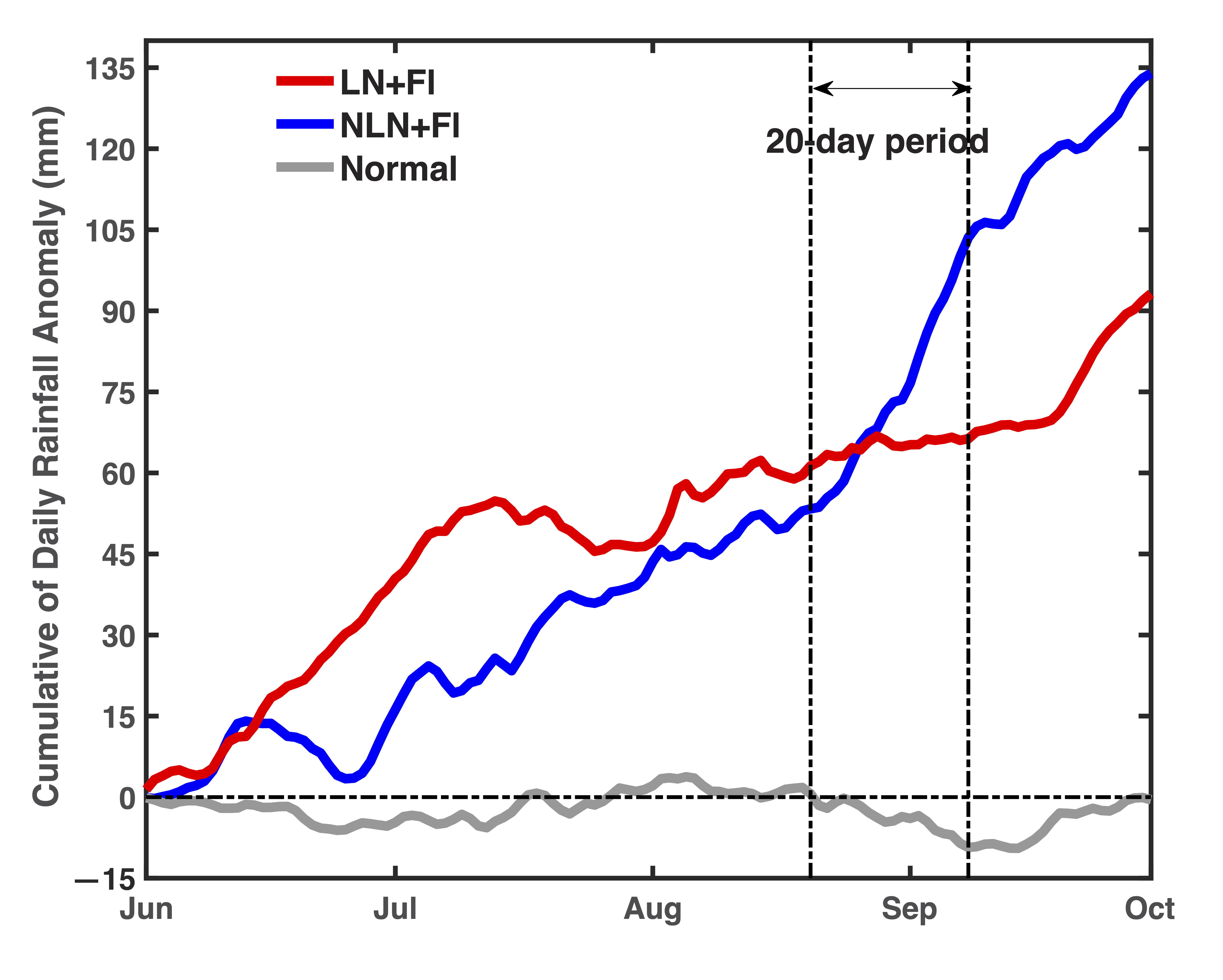
Using observations and reanalysis, we show that the floods in the absence of La Niña follow a unique evolution pattern within the monsoon season itself. Instead of steady rainfall throughout the season, these floods are driven by an intense burst of rain late in the season (blue line in the Figure on left). This late-season surge results from a complex interhemispheric interaction of (i) a wave train from the northern midlatitudes that curves southward into the subtropics and (ii) an enhanced low-level jet which is linked to a stronger pressure difference between Madagascar and the Indian subcontinent. Together, these processes trigger heavy rainfall over India. Our findings reveal a new dynamical pathway that explains that the large-scale monsoon floods can result from interactions between hemispheres, offering fresh insight beyond the traditional tropical ENSO-based view.
This work has been submitted to Geophysical Research Letters and is not yet available online. Please feel free to contact me if you’d like to discuss it.
Impact of weakening of AMOC on the UTLS warming over the extratropical North Pacific
Read more
Influence of AMOC weakening on the Atlantic tropical cyclone activity
Read more